In volatile markets, many organizations face a quiet but critical crisis: the widening gap between strategic ambition and the capacity to execute it. Executive teams rarely lack ideas or strategic frameworks, but they often overestimate how prepared their people and systems are to carry the weight of strategy.
This is where the idea of Human Capital as the CEO’s “wingman” becomes more than rhetoric. Properly understood, it signals a structural shift in responsibility. The role is no longer administrative support, nor even cultural stewardship. It is performance architecture. And the KTM Framework provides a blueprint for how that architecture can be built.
From HR Support Function to HR Wingman
The traditional HR model was designed for operational stability. Today’s environment demands something fundamentally different. A CEO navigating uncertainty does not need another reporting layer, but a strategic partner who ensures that organizational capability keeps pace with strategic ambition.
An effective HR wingman operates at the intersection of talent, systems, and business outcomes. The mandate is not to run programs, but to engineer execution capacity.
The KTM Framework: A Performance Hierarchy
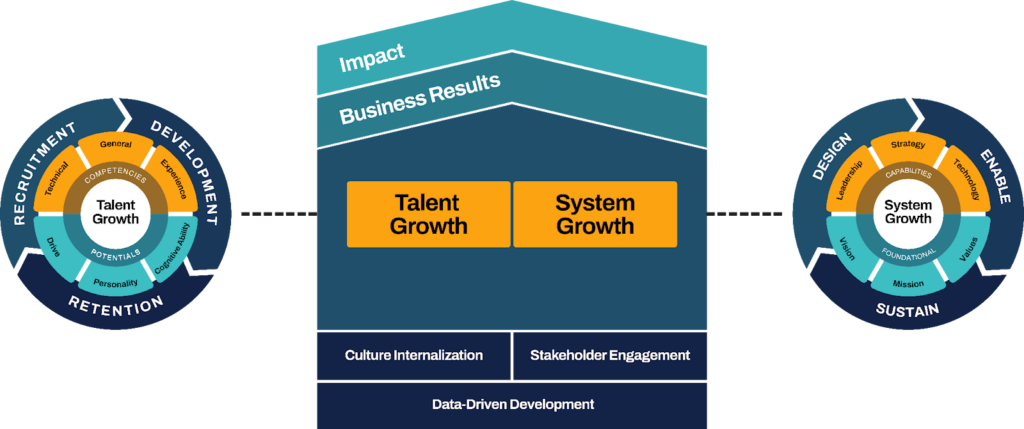
At the top of the framework sits a disciplined hierarchy: Impact leads to Business Results, which are driven by synchronized Talent Growth and System Growth. The ordering matters. It rejects activity-based metrics as proxies for success. Training hours, engagement surveys, and policy rollouts are not ends in themselves. They are relevant only insofar as they produce measurable business outcomes.
This performance-first orientation reframes the mandate of Human Capital. If impact is the destination, then capability is not a program, it is a lever of competitive advantage. The resource-based view of the firm has long argued that sustainable advantage stems from valuable, rare, inimitable, and well-organized resources. Human capability meets all four criteria when it is aligned with system design, but this only happens when it is deliberately engineered. That engineering discipline defines the true HR wingman.
The Dual Engine: Talent Growth and System Growth
The framework’s most consequential contribution is its insistence on a dual engine: Talent Growth and System Growth. Organizations frequently invest in one while neglecting the other. They recruit aggressively and design leadership programs, yet leave outdated operating models untouched. Or they implement structural reforms without upgrading the capability depth required to operate within those reforms. In both cases, friction replaces momentum.
Talent Growth: Building Execution Density
Talent Growth spans recruitment, development, and retention. This lifecycle approach recognizes that execution capacity is cumulative.
- Recruitment defines the baseline quality of input.
- Development determines capability velocity.
- Retention stabilizes institutional memory and preserves compounding expertise.
When these elements operate coherently, talent density increases, and with it, the organization’s strategic optionality. An HR wingman ensures that talent strategy is not reactive hiring, but a deliberate capability roadmap aligned with long-term business priorities.
System Growth: Designing for Performance
Talent density alone does not guarantee performance. System Growth provides a structural framework through the following definitions:
- Design clarifies authority, accountability, and coordination.
- Enable equips teams with tools, data transparency, and operational clarity.
- Sustain reinforces governance and cultural alignment over time.
Without this structural backbone, even highly capable individuals expend energy navigating internal complexity rather than creating external value. The HR wingman mindset insists that system design is not an operations issue alone. It is a strategic capability issue.
Resilience as Strategic Infrastructure
The framework embeds a nuanced distinction between organizational resilience and individual resilience. This distinction is not semantic; it is strategic. Organizational resilience depends on distributed authority, real-time situational awareness, and trust-based leadership. Individual resilience depends on psychological safety, purpose alignment, and perceived progress. One cannot substitute for the other. In turbulent environments, both must be cultivated simultaneously to avoid systemic brittleness.
Culture, in this model, is not presented as messaging or branding. It functions as infrastructure. Culture internalization ensures behavioral consistency across layers of the organization. Stakeholder engagement secures cross-functional legitimacy for change initiatives. Data-driven development introduces empirical discipline into capability investment. Together, these foundational elements reduce noise and prevent strategic drift. Culture becomes a performance stabilizer, not a communications campaign.
What It Takes to Be a True HR?
For Human Capital to truly operate as the CEO’s wingman, it must assume ownership of this synchronization. That requires a level of business acumen that extends beyond functional expertise. It demands fluency in strategy, capital allocation logic, and performance measurement. It also requires the discipline to evaluate initiatives through a start–stop–continue lens — prioritizing impact over tradition.
Impact must take precedence over tradition.
This reframing has practical implications. When strategy shifts, the first question should not be, “What program do we launch?” but rather, “What capability gaps threaten execution?” When performance stalls, the diagnostic should not default to motivation or incentives, but extend to system design misalignment. When talent attrition rises, leaders should examine whether growth pathways and structural enablement remain coherent.
Synchronization as Risk Management
In stable environments, inefficiencies can remain hidden beneath favorable market conditions. In volatile environments, misalignment compounds rapidly. The synchronization of Talent Growth and System Growth is therefore both a performance strategy and a risk management strategy. It strengthens the organization’s ability to absorb shocks without sacrificing forward momentum.
Because the HR wingman does not merely optimize HR processes. They reduce strategic fragility.
The CEO Needs Capacity, Not Ceremony
Ultimately, the KTM Framework advances a disciplined thesis: sustainable business impact emerges when people capability and system architecture evolve together, reinforced by culture and guided by data.
This integration transforms Human Capital from an activity center into a strategic integrator.
The CEO does not need additional reports or new leadership slogans. What the CEO truly needs is a partner who ensures that ambition is backed by structure, where strategy is supported by real organizational capability, systems enable execution rather than limit it, and resilience is deliberately built into the organization.
This is the role of an HR wingman. The role is not about symbolic closeness to leadership, but about taking operational responsibility for strengthening the organization’s capacity to win.