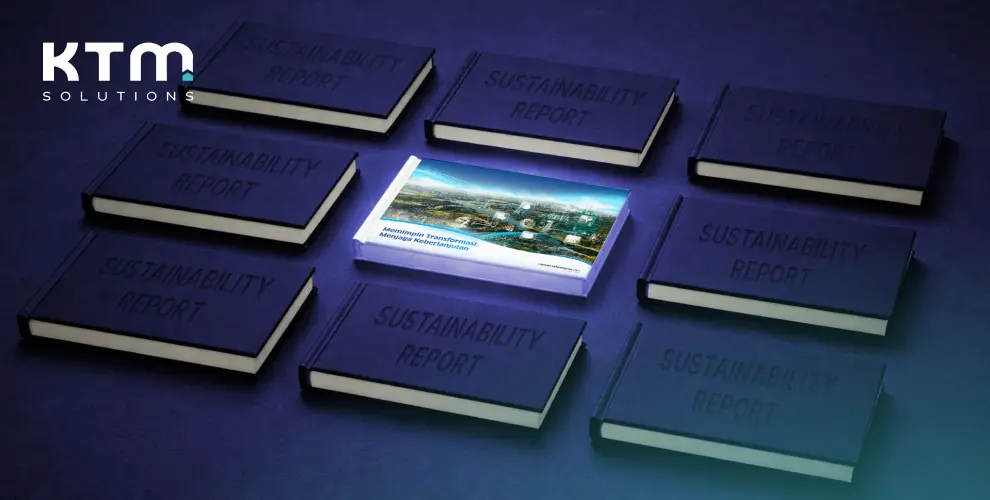
In Indonesia, there are more than 900 publicly listed companies, and nearly 66 million businesses overall. But how many truly tell their sustainability reporting; honestly, transparently, and strategically? From our experience working on Sustainability Reports (SR) across sectors, the answer is: not enough.
While several of Indonesia’s largest corporations have reached global sustainability reporting benchmarks, progress remains uneven. For many others, sustainability reporting is still approached as a design exercise rather than a strategic communication tool. It’s not uncommon for us to find companies preparing their reports with the help of printing or creative agencies, focusing heavily on layout, visuals, and storytelling flair.
The result? Reports that look good, but say little about what really matters: how the business operates, manages risks, and creates impact.
The Design Trap: When Storytelling Overshadows Substance
This design-first approach comes at a cost. Investors, regulators, and even the public are increasingly demanding more than glossy pages. They want disclosure, evidence, and want governance.
Yet in many SRs we’ve reviewed, data about greenhouse gas emissions, waste management, supply chain integrity, or employee welfare are often hidden in the fine print, if disclosed at all. Governance and verification details are sometimes missing. And in many cases, there’s little linkage between sustainability initiatives and actual financial or operational outcomes.
Indonesia’s regulation (POJK 51/2017) has made SR mandatory for public companies, a positive step forward. But regulation alone doesn’t guarantee quality. The difference between compliance and credibility lies in how deeply companies understand and disclose their business process and impact.
Global Standards Are Moving Fast, and Indonesia Must Catch Up. While local regulations provide the floor, global standards are quickly raising the ceiling. The International Sustainability Standards Board (ISSB) introduced IFRS S1 and S2 to reset expectations on corporate reporting. These frameworks require companies to integrate sustainability and climate-related information into financial reporting. By doing so, sustainability is positioned as a core business consideration rather than a standalone PR exercise.
We’re proud to have helped one of the earliest adopters of IFRS S2 in Indonesia, guiding them through disclosure mapping, data system readiness, and governance alignment. That experience showed us one thing: being early matters. Companies that align early don’t just comply, they lead.
And this leadership doesn’t go unnoticed. Investors increasingly reward companies that provide transparent, decision-useful sustainability information.
visual
From Compliance to Credibility: Why Disclosure Quality Drives Trust and Value
The link between sustainability reporting and business value is no longer anecdotal, it is increasingly supported by evidence. Research by Nugrahani et al. (2023) shows that sustainability reporting among Indonesian public companies is still largely shaped by institutional pressure rather than strategic intent. Regulatory requirements and mimetic behavior encourage compliance-focused reporting, often prioritizing form over substance. As a result, disclosure quality particularly in governance practices and stakeholder engagement, positioning sustainability reports as symbolic tools for legitimacy rather than decision-useful instruments. Crucially, the study highlights a clear differentiator: companies that embed ESG considerations into their core business strategy tend to build credibility faster and earn stronger investor confidence.
A Structural Shift Is Underway: IFRS S2 and the Rise of Investor-Grade Reporting
These challenges are further reflected in IAMI’s (2024) assessment of Indonesian companies’ readiness to adopt IFRS S2. Fewer than 40% currently meet the required disclosure elements, and only 3% explicitly reference the standard, underscoring how early the adaptation journey still is. Yet within this gap lies a strategic opportunity. Early adopters of IFRS S2 are better positioned to set market benchmarks, differentiate themselves from peers, and strengthen their appeal to investors and regulators. The formal adoption of SPK 1 and SPK 2 by the Indonesian Institute of Accountants (IAI) in 2025 marks a critical inflection point. Effective from January 2027, these standards require sustainability disclosures to be integrated into financial reporting, firmly positioning ESG as a core dimension of business performance. This shift raises expectations around governance quality, data reliability, and assurance pushing sustainability reporting in Indonesia beyond visually compelling storytelling toward disclosures that are credible, decision-useful, and strategically anchored.
Our Philosophy: Walk the Talk, Not Talk the Talk
At KTM Solutions, we take pride in being practitioners before consultants.
Our team is composed of professionals who have managed sustainability programs from inside organizations, navigating stakeholder expectations, balancing budgets, building systems, and learning firsthand what works and what doesn’t. That’s why we understand the difference between a report that ticks the box and a report that moves the needle.
We don’t just write; we translate your operations, governance, and impact into an investor-grade narrative that stands up to scrutiny. We make your report not just a regulatory requirement, but a strategic asset that strengthens trust and unlocks opportunities.
Why a Strong Sustainability Report Is a Strategic Advantage
A well-prepared sustainability report does far more than please regulators. It can:
- Reduce your risk profile and cost of capital.
- Strengthen your brand credibility among partners and investors.
- Open access to sustainability-linked financing.
- Align your internal teams around measurable sustainability goals.
- Build lasting stakeholder trust — from employees to the market.
But it starts by going beyond the surface. If your Sustainability Report today feels more like a brochure than a disclosure, maybe it’s time to tell your real sustainability story.
Ready to Take the Next Step?
We have successfully supported clients across sectors in the preparation of their 2025 Sustainability Reports, aligned with IFRS S2, GRI Standards (2021), and POJK 51/2017. For those responsible for their company’s ESG, CSR, or Sustainability Report and seeking to ensure investor readiness, we invite you to collaborate with us.